Wednesday, March 22, 2023

Heart's Delight

Remembering what is important.

This post has little to do with sailing or boats or marine science.  This one's from Damon.  It's personal.

Ten years ago last week, on March 14, 2013, I had a heart attack. I'd felt increasing pain and fatigue for five days, but I did nothing about it. Despite the fact that I have a deep family history with heart disease, and knew what was happening, I was in denial. I did the dumbest thing possible: waiting until I was having a full-blown heart attack before taking any action. I was 44 years old and an avid runner who lived a pretty healthy lifestyle. My story is not that unusual, but it contains some useful lessons. Surviving a heart attack has been a liberating experience; it has actually been one of the best things to happen to me. Here is some of what I learned over the past decade:


1. Your risk of having a heart attack is influenced by 3 things: Your heredity, diet, and lifestyle. A junk food junky who leads the most sedentary life can have a healthy heart if they have "good genes." Conversely, you can lead the healthiest life and still have a heart attack if you have "bad genes."


2. Physical fitness is crucial. So why should you bother to exercise and eat well if it's all about your genetics? The important point is that genes are not the only factor. It's not just a game of chance. Nothing is entirely in your control but you do have a large influence on your health. Someone who is genetically predisposed to coronary artery disease can delay that heart attack by years simply by taking good care of themself. Someone with just "moderately bad genes," may be able to prevent that heart attack entirely. But here is the important thing: heart attack sufferers who were physically fit prior to the attack are more likely to survive and are more likely to return to a normal life than are those who were sedentary and/or overweight.

"Use it or lose it" is the perfect description of your health and fitness. People don't stop exercising because they get old, they get old because they stop exercising. You don't have to be a runner or competitive athlete to have a healthy heart. Anything that increases your activity level helps. Just use your car and your couch a little less.

Snowshoe racing is a thing.  Racing at Bradbury Mountain in Maine, 2016.

3. Don't ignore the symptoms. I suffered from a combination of being embarrased to find out that I may just be having acid reflux, of being in denial, and of being just plain stubborn. This almost killed me. The ER doctor told me that if I had waited another couple of hours to come into the hospital, I probably would have died. My symptoms started out as mild fatigue and an achy back. At first, I thought I was just coming down with the flu. Then it progressed to pain in my throat and jaw, before developing into the classic symptoms of pain in the chest and left arm. I remember these sensations very clearly because the ER doctor looked me straight in the eye and said:

"Remember all the symptoms that you've been feeling. Burn them into your memory. If you ever feel them again, call an ambulance. Don't wait five days to do something because you'll probably end up dead. You were very, very lucky this time."

Her speech should have concluded with "You idiot." Being the professional that she is, she left that part unsaid. But the message was clear. The only reason I survived my foolish delay in treatment was that my heart was very strong. If you feel these types of symptoms and they get worse during or after mild exertion, get someone to drive you to the hospital or call 911 immediately. Don't be that idiot.


4. A heart attack doesn't have to be the end of your world. Of all the life-threatening diseases to have, cardiovascular disease is actually one of the best! The ultimate cause is genetic and biochemical. That stuff is really complicated and researchers are still trying to figure out how it all works. But the result of all that biochemistry is a plumbing problem. Just like a drain pipe, your coronary arteries can get clogged. And just like plumbers, cardiologists can pinpoint the problem and open up that clog. In most cases now, the procedure is pretty simple: angioplasty and stenting. In fact, I was awake for the entire procedure. The surgical team knew that I was a biologist so they turned the video monitor so I could see my heart and the catheter being fished up into my coronary arteries, as well as the view from the catheter inside my arteries. It was so cool; I just wished I didn't have to pay the price of admission for this movie. As I watched the doctor put the stent in place in my heart, I felt better instantly.

As a kid growing up in the '70s and '80s, I had known people with advanced heart disease. Back then, it seemed like people either died suddenly of a heart attack or they slowly withered away. The diagnosis back then was a death sentence. But that is certainly not the case today. Fifty years of medical science has made huge advances in treating this disease. About 8 weeks after my heart attack, I ran a 5k race. I didn't run fast, but it felt so good, so normal, to be out running with people. With approval and guidance from my cardiologist, I was able to resume running and racing all-out. I have competed in half marathons, trail races, mountain races, and snowshoe races. In 2015, I won my age group in the U.S. National Snowshoe Championships and qualified for the National Snowshoe Team (Unfortunately, I wasn't able to compete in the world championships because of a calf injury).


5. Having the right doctor for you matters. When I was in the hospital, I saw a lot of different doctors, usually for very short visits. They'd prescribe something and then I wouldn't see them again. By the time I was released I had a bag full of prescription meds. In the first couple of weeks after being released, I continued to be very fatigued, to the point where I'd fall asleep at all times of the day, even at work. Something wasn't right, so I started wearing my heart monitor all the time (which I normally wore during running workouts). What I found was that my resting heart rate was dropping below 30 beats per minute (the monitor stops recording at 30 bpm, so I'm not sure how low my pulse actually got). When I went to see my new cardiologist about a week or two after my heart attack, he took the time to get to know me and recognized that I wasn't the typical cardiac patient. One of the drugs that I was given suppresses the heart rate. It is a common medicine prescribed to heart attack survivors that allows their heart to rest. Given that my resting pulse was naturally in the 40s, I didn't need that drug. So he told me to stop taking it and I immediately felt "normal" again.

After lots of tests (EKGs, ultrasounds, stress echo tests, etc.), my cardiologist told me that other than the blockage that had been re-opened, I had a healthy, strong heart. And he encouraged me, under his close supervision, to slowly build back up to the level of running that I was at prior to the heart attack.


Racing at the 2015 Granite State Snowshoe Championships (a 10k race that featured 1,500' feet of elevation gain).  I won the masters' division of the Granite State Snowshoe Series that year.


6. Having role models is important. One of the things that buoyed my spirits and inspired me to get back out there and live a full life was the realization that there are lots of people leading active lives with conditions similar to mine. Having grown up in Massachusetts and being a runner, one of the highlights of the year was watching the Boston Marathon. Ever since I can remember, Team Hoyt, consisting of father Dick and son Rick Hoyt, competed in the marathon. Rick has cerebral palsy and is a quadriplegic. Dick would push his son in a wheel chair for the entire 26.2 miles. But it wasn't just the Boston Marathon; they competed in over 1,100 endurance events including 72 marathons (32 Bostons) and 257 triathlons (6 Ironmans). At the age of 50, Dick ran the Marine Corps Marathon in 2:40 while pushing Rick in his wheelchair, which was the fastest time posted by any runner in the over 50 age group. In 2003, at the age of 63, Dick had a heart attack. Following his recovery, he and Rick returned to competition, running their last marathon together in Boston in 2014.

I have other role models who are much closer to me. My older brother, Bill, has a similar condition. He had his first experience with cardiac care several years before me and he returned to his normal, active life, which includes playing ice hockey a couple of times per week. My father-in-law had bypass surgery in the 1990's, a much more invasive procedure than stenting. He, too, returned to an active life. Now at age 91, he is in better shape than most 60 year-olds.

Following a cardiac crisis, your prognosis is largely up to you. You can decide to withdraw and lead a sedentary life, which will be the beginning of the end. Or you can decide to be active, which will help maintain your heart's strength and health. Looking at the health outcomes for people who chose the latter helped inspire me to do the same.

Janet and I with her dad, Charlie, 26 years after his bypass surgery.

7. Insurance matters. Luckily, my employer had an excellent health care plan. The total cost of my care for the heart attack was approximately $50,000. We paid less than $1,000 in copays and deductibles. Because of this good quality insurance, we never had to make any difficult decisions regarding the cost of treatment. If it wasn't for our insurance plan, this health crisis could have triggered a financial crisis. Healthcare is the #1 reason why individuals have to declare bankruptcy. We are very fortunate. Not everyone is as lucky.

The souvenir I got for my experience, a wallet card with the model number of the stent and information on where it was implanted. 


8. Cardiac rehabilitation is important. I had been an athlete for my entire life. I really thought that my body was indestructible. The heart attack caused a profound loss of confidence in my body. It's difficult to regain that confidence, but it's vitally important to do so. Remember that bit about using or losing your fitness? You have to get back out there and be active.

Cardiac rehabilitation is what restored my confidence and allowed me to regain my fitness. It is essentially like going to a gym to workout, except that you do it while being hooked up to EKG and blood oxygen monitors, and exercise physiologists and medical technicians watch the monitors as they guide you through individually-tailored exercise sessions. In this way, you can safely increase your fitness, regardless of your initial fitness level. And you can prove to yourself that your body is still capable of exercising. Cardiac rehab is especially useful when combined with the results of a stress-echo test. Immediately after my heart attack, I was hyper-vigilant about any new pain or sensation. I was paranoid. But after a few weeks of cardiac rehab, my confidence grew and I simply stopped thinking about my heart. Over the past decade, I have spent much more time worrying about my achilles tendons than I have about my heart.
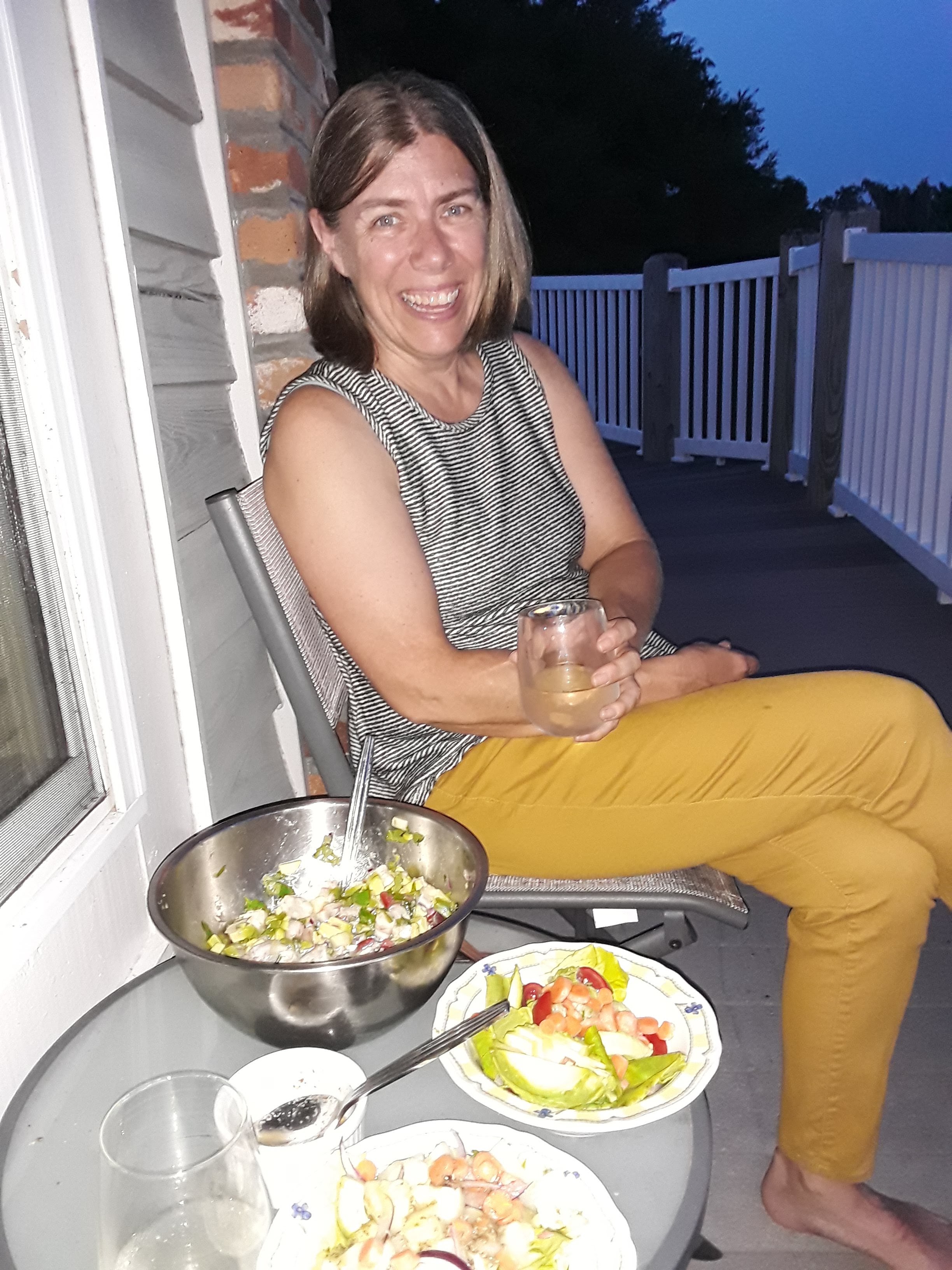
"Healthy" doesn't have to be boring.


9. Having a heart attack was one of the best things to happen to me. It sounds trite but life threatening experiences can be liberating and a source of motivation. It makes you realize what's really important. For years, Janet and I had been talking about getting a bluewater sailboat and cruising for a couple of years. Up to that point, it was all talk. As soon as it became clear that I was going to make a full recovery, we got serious about those plans. We realized that we shouldn't wait until our 60s or 70s; life is too unpredictable. If it hadn't been for my heart attack, we wouldn't be out cruising today.

I don't actually recommend that you go out and have a heart attack, or any other life-threatening condition. Just take my word for it; life is short, live it while you can.

Janet posted in her An Ocean Lover in Maine blog about this back in 2014. It's interesting to read her perspective, one year after my heart attack.

Thursday, March 16, 2023

Don't Buy a New Boat!


The admonition in the title of this post may seem strange, coming from a couple of boat fanatics.  But we're also dog lovers and feel pretty strongly that people should adopt dogs from shelters, rather than buy puppies from breeders.  Our logic is the same in both cases: there are already plenty of good dogs and good boats that just need loving owners. 

In our previous post, we discussed the rampant problem of derelict boats in Florida.  It's a complicated, multifaceted problem that has no simple solution.  One thing that could help is if people would stop treating boats like disposable items.  Are we suggesting that instead of buying a new boat you should go and get yourself a long-neglected, derelict boat?  Not necessarily.  It doesn't have to be a derelict, just not a new boat.  But for the right type of person buying a diamond in the rough can be a good value.

A lot of these older boats that are being neglected are well-designed, well-built boats that would have plenty of life left, in the hands of the right owners.  You could easily spend over a half-million dollars on a brand new cruising boat.  On the other hand, you could spend next-to-nothing on a neglected boat and bring it to a decent boatyard for a complete refit or DIY if you have the skills, tools, and time.  If done properly, the results could be a boat that is every bit as good as a new one, for a fraction of the cost.  And there would be one less plastic boat hull in the world.  Besides, old boats are just more beautiful than the soulless, angular barges being built today.  And they often sail better and are more capable offshore, too.    

Right up front, it is important to be able to distinguish a diamond in the rough from a cow pie.  Having to replace the engine or the entire rig would not necessarily be a deal breaker, as long as you knew this from the outset and included these costs in your calculations.  But what is essential is that the hull must be structurally sound.  Nothing else about the boat matters if the hull is irreparably compromised.  Not all boats are worth saving.  Seeking the opinion of a marine surveyor or of a trusted fiberglass repair specialist can prevent problems down the line.  Captain Fatty Goodlander's book How to Inexpensively and Safely Buy, Outfit & Sail a Small Vessel Around the World is a good resource, as is this Practical Boat Owner article giving tips on how prospective buyers should go about inspecting boats.

There are yacht brokers and boatyards that specialize in giving old boats a second life.  Here are few examples:

  • Atom Voyages: specializes in outfitting smaller, older boats for offshore sailing.
  • Certified Sales, Inc.: buys and sells used boats, including insurance salvages.
  • Pacific Seacraft Yachts: Builder of fine yachts.  Because their boats are so well-built and last forever, much of Pacific Seacraft's business has shifted into refitting their older boats. There are a lot of advantages to getting a boat refit by the same company that originally built it. (Full disclosure: Pacific Seacraft built our boat, Fulmar).
You can also find used boats for sale by owner at sites like sailboatlistings.com, Sailing Texas, as well as on Craig's List and Ebay.  And, of course, if you want to go through a yacht broker, there is always Yacht World.  Another strategy is to simply visit marinas and boatyards to search for boats that look like they haven't had much love in a while.  These businesses don't like having such high risk boats taking up space at their facilities.  Often, the yard manager will be quite happy to help you contact the boat's owner to find out if they're interested in selling. 

Here is a beautiful 1974 Cape Dory 28 that we saw in Titusville.  For less than the cost of the average used car, this capable boat can take its new owner just about anywhere in the world (see the listing on YachtWorld).

Be realistic about your finances and your own abilities.  Boats always cost more and take more time and energy than you expect (see this article in Good Old Boat).  The adage is true: "A boat is a hole in the water into which you pour money."  So you're better off with one that is a little too small for your needs than one that is too large or too complicated for your wallet or skills.  And if you are a novice boater, start with a small boat.  You will make mistakes, some of which may be costly.  Better to have these learning experiences on a relatively inexpensive boat.  Costs of storage, maintenance, operating, and repairs increase exponentially with the length of the boat.  And catamarans are exponentially more expensive and more complicated than monohull boats of the same length.  It's also really difficult to find a boatyard or marina that can accommodate catamarans that have a beam wider than 16 feet.     

In the words of Lin and Larry Pardey: "Go small, go simple, go now."


Addendum related to our previous post: In its spring 2023 legislative season, Florida's lawmakers will be considering an addendum to the existing anchoring laws, Florida Senate Bill 1502.  Judging from the locations of the new proposed anchoring restrictions, it seems like NIMBYism is alive and well in the Sunshine State. 

Thursday, March 2, 2023

Florida's Epidemic of Derelict Boats


Florida is ground-zero for the "anchoring wars."  These controversial measures limit the rights of boat owners to navigate and anchor freely on the state's waterways, which, of course, are public.  When this first became an issue more than two decades ago, it seemed to be a pretty clear case of NIMBYism.  Wealthy waterfront homeowners didn't want their views spoiled by anchored boats.  But the problem has grown into a legitimate issue.  The number of neglected and abandoned boats has reached epidemic proportions in Florida.  It seems that everywhere you look along the Florida coast, you see boats sunken in anchorages and driven up onto the shore.  From where we anchored one night off of Bethune Point in Daytona, we could see no less than 14 wrecks.  And if you look around the anchorages, marinas, and boatyards in Florida, you see a large number of boats that are severely neglected, just waiting to become future wrecks.  For years, we've simply referred to such hard-looking vessels as "Florida boats."  

So why is the derelict boat problem so much worse in Florida than in most other coastal states?  It seems to us that there are multiple drivers: 

1.  Lots of boats. There are more than a million boats registered in Florida.  And if you look at the home ports written on the sterns of boats in marinas and anchorages, you'll see that an awful lot are from out of state.  (Just like our boat.)  So the actual number of boats in Florida is likely much higher than a million.   

2. Many novice boaters.  One in every 20 Florida residents owns a boat.  On average, 3,000 people move to Florida every day.  Most of these people move close to the coast.  A lot of them think: "You know, I've always wanted to have a boat."  So some of these transplants buy a boat, which is often their first boat, first large boat, first boat on the ocean, or first boat moored in a hurricane zone.  Some of these novice mariners have no idea how to maintain their boats and become discouraged when they learn how much work and money it requires (even for a brand new boat).  In many cases, their interest in the boat evaporates quickly.  Or, another thing that happens with surprising regularity in Florida is that the boat owner becomes ill or dies.  They don't call Florida "God's Waiting Room" for nothing.  After the owner is gone, their family may have no interest or ability to deal with the boat. 

3. Schizophrenic weather.  Florida's weather is characterized by long periods of relative tranquility, punctuated by brief episodes of fury.  Thunder storms, tropical storms, hurricanes, and winter cold fronts wreak havoc. The tranquil weather lulls people into a false sense of security. 

4. Year-round boating.  Because the weather is warm enough for boating year-round, there isn't an annual haulout season, and a lot of boats go for long periods between haulouts, leading to "deferred maintenance."  Contrast this with boats in the north, which are in the water for less than six months out of the year, allowing time for maintenance.  This also means that every fall, harbor masters in northern ports get a chance to easily identify derelict boats.  If all the boats in a harbor are hauled out in October, except for one, then the harbor master has a chance to track down that owner and deal with that one boat before it sinks and causes problems.  In Florida, it's more difficult to identify newly-abandoned boats, the numbers of which keep increasing over time. 

5. Lack of harbor masters.  Love'em or hate'em, most New England ports have harbor masters; one local authority whose sole responsibility is to know everything that's going on in their harbor.  Ports in Florida are patrolled by law enforcement officers from the state's Fish & Wildlife Conservation Commission and, in some cases, by local law enforcement (whose efforts seem sporadic at best).  Their mandates are broader, their jurisdictions are geographically larger, and the number of boats using their waterways are much higher than what marine law enforcement agencies face in other states.  So they don't have the time or resources needed to do the type of community policing that is required to identify and deal with every problem boat.  

6. Housing insecurity.  The fact is that Florida has a huge number of homeless people and others who are on the margins of society.  For many of these people, living on a boat is an attractive option.  They can buy a boat for next to nothing (they're not sailing or cruising so they often don't care if the engine works, it has any sails, or the rigging is sound) or they can simply squat in an abandoned boat.  They can then anchor out for free; no mortgage, no rent. And being far away from other people means that they generally won't be bothered by anyone. There are many nice people in this group.  But there are also a lot of damaged people with addictions and all of the problems that follow.  For example, when we lived in Sarasota in the 2000s, there was a growing population of liveaboards on ramshackle boats in the local anchorage.  These boats, for the most part, were incapable of moving anywhere and definitely were not pumping out their wastewater.  Due to all the raw sewage from these boats going directly into Sarasota Bay, several people in the area contracted hepatitis A.  During that same period, we had two nice sea kayaks stolen from our backyard.  We found both of the kayaks a few days later tied to some very rough-looking boats in the anchorage. (This is a funny story in itself, the moral of which is never steal a boat from people who work on the water.  Also, never cross Janet; she will hunt you down like a bloodhound.)  These are the types of societal problems that accompany derelict boats.  Not surprisingly, these decrepit boats in the anchorage suffered very high rates of grounding and sinking every time the wind blew.  To be clear, there are plenty of nice, well-maintained yachts that sink or get blown ashore.  But for a lot of boats, the path to dereliction begins with neglect. 

You may not be able to tell from this shot, but the mainsail on this boat is a (very expensive) laminate racing sail, neatly flaked on the boom (perhaps put back on the boat after the storm?).  The fancy mainsail and other equipment onboard indicates that this was a well-cared for racing boat.  It, and the other boats shown in this post, probably came ashore during Hurricane Ian (Sept 2022) or Hurricane Nicole (Nov 2022).

So what's the big deal?  Does it really matter if there are derelict boats littering the shoreline?  These wrecks are more than just an eyesore; they're an environmental hazard.  They physically damage sensitive sea grass beds, mangrove forests, and coral reefs, all of which provide vital ecological services.  And each of these wrecks contains toxic petroleum (tanks of fuel and oil), heavy metals (batteries and antifouling paint), and lots and lots of plastic.  If you are concerned about plastics in the environment, then all of these fiberglass (aka plastic) boats breaking apart should alarm you. 

This 42-foot Endeavor ketch was well-loved by someone.  That custom-welded stainless steel solar arch/pushpit/dinghy davit is a work of art and appears to be brand new.  The canvas also looked nice (at least before the storm beat it to death).   

Why don't "they" just clean up the mess and haul these boats away?  The short answer is because it's expensive and logistically difficult.  The boat owner is legally responsible for paying for the cleanup.  But, often the owner can't be identified, is financially incapable of covering the costs, or has passed over the rainbow bridge.  Many of the boats are uninsured and sometimes the owners go to great lengths to remove all identification markings (e.g., name, home port, registration/documentation #, hull ID #, and engine serial #) so they can't be held responsible.  This puts the burden of cleanup on local governments, and the costs for a community to clean up the derelict boats after a storm can run into the millions of dollars.  But the first hurdle faced by a local government or waterfront property owner wanting to get rid of a boat cast ashore is the fact that it is someone else's property.  That boat, even if it is a wreck, has a legal owner somewhere and it may have some value.  By carting it away (which usually involves demolition), you are taking and destroying someone's property.  "Salvage rights" are not so simple.  Taking someone else's property is kind of a big deal in our country, so the legal system intentionally makes it a difficult process.   

It's clear that an ounce of prevention is worth a pound of cure.  But many of the preventive measures taken by Florida and some of its local municipalities have seemed like harassment and a violation of boaters' rights to navigate public waterways (rights guaranteed in the Commerce Clause of the U.S. Constitution).  There have been limits to the amount of time a boat can remain anchored in one place, prohibitions on anchoring in certain areas, and prohibitions on living aboard boats in certain areas.  Several cases have wound up in court, with some local anchoring ordinances being found to be arbitrary and capricious, or just plain unconstitutional. 

One afternoon when we were out for a ride in our dinghy, we came upon this scene of a derelict boat being plucked from the shore.  It was an impressive, sad sight.  This is about the easiest cleanup one can imagine.  The boat came to rest on the shore of a public park, right next to a boat ramp, so access was easy.  And the boat itself was on the smaller side (a 28-31' sloop, looks like a Hunter).  The boat was to be loaded onto that flatbed trailer you see being towed by that white truck on the right. 

The crane struggled mightily to pick up the boat.  As the crane backed up slowly toward the trailer, the operator had to stop occasionally to deploy the stabilizer legs so it wouldn't tip over.  This sort of work takes nerves of steel or brains of rock.  The boat was far too large to lay on the trailer on its side.  So the crew commenced chopping it up with chainsaws.  The first thing they tried to cut off was the rudder.  Word of caution to anyone attempting this sort of operation in the future: the internal structure of a rudder is stainless steel, which chainsaws do not like.  

So what's the solution?  We won't even pretend to know the answers, other than to say it's complicated.  This issue involves a conflict between the rights of individuals to use public waterways and the ability of a community to safeguard its citizens and its environment.  It also pits the private property rights of the boatowners against those of the waterfront land owners (who tend to be very wealthy and politically well-connected).  And it is intimately linked to housing insecurity, one of the most pernicious, stubborn problems in our society. It is  obvious that addressing homelessness has to be part of the strategy.   

The problem of derelict boats will probably never be solved completely in Florida.  But the current situation is unsustainable, both economically and ecologically, and has to be brought under control.  Boaters who simply want state and local governments in Florida to take an entirely hands-off approach are being unrealistic, in our view.  But the focus must be on environmental protection, public health & safety, and preservation of constitutional rights to free navigation, not on NIMBYism.  There has to be some give and take.  In other words, we need actual governance.       

This boat came to rest about 30 feet from the Endeavor pictured above and about 200 yards from the boat that was chopped up and carted away.  There are at least a half-dozen more wrecked boats within a mile of this spot.


Thursday, February 16, 2023

Musings on Mangroves

Barnacles and oysters growing on the prop roots of a red mangrove (Rhizophora mangle) in the Indian River Lagoon.

A really cool thing happened as we were heading south in the Atlantic Intracoastal Waterway, down the coast of Florida: we started seeing mangrove trees scattered throughout the salt marsh.  Maybe that’s not as cool as spotting Tom Brady or Lady Gaga, but they’re busy people who don’t have time to just hang out on the banks of the ICW. (Well, maybe Tom has some free time now that he has re-retired.)  But mangroves are super cool and they, too, are busy…busy marching northward, that is.  

Let’s start with a little background.  What are mangroves and why are they so cool?  Well, first, they are trees that live in seawater.  As if that wasn’t cool enough, they’re also ecosystem engineers, meaning they create habitat for other species: mangrove forests.  It’s a forest community in the intertidal zone of the ocean.  Mangrove forests form in protected bays and estuaries in the tropics and subtropics.  In many ways, mangrove forests are the ecological equivalents to salt marshes found in temperate regions.  Lots of marine species, including many that humans like to catch and eat, depend on mangrove forests.  The iconic prop roots of red mangroves provide a solid surface for the attachment of sessile invertebrates such as oysters, bay scallops, and barnacles.  The tangled, 3-dimensional maze of prop roots also shelters countless fish, including prized sport fish such as mangrove snappers, snook, sheepshead, and juvenile goliath grouper. The canopy of the mangrove forest teems with insects, seabirds, shorebirds, and songbirds.  You can even find land mammals, such as raccoons and bobcats, scampering among the branches. 


In addition to providing habitat for a myriad of critters, mangroves also protect human habitat. Their roots trap sediments and stabilize shorelines, helping to protect coastal towns by preventing erosion and buffering the shore from storm-driven waves and floodwaters.  


Mangrove forests, along with salt marshes, seagrass beds, and freshwater wetlands, are also really good at capturing and storing climate-warming carbon dioxide.  Like all plants, mangrove trees “suck” carbon dioxide out of the atmosphere.  They use that CO2, along with sunlight and water, to produce their own food (sugar) via the process of photosynthesis.  A lot of that food that they create is used to build their tissues, such as roots, branches, bark, and leaves, just like how your body will take that ham & cheese sandwich you ate for lunch and turn it into muscle and bone.  Mangroves are very long-lived and their tissues (i.e., wood) are very stable. So once that carbon-containing tissue is built, it takes that carbon out of circulation for decades or centuries, meaning that it won’t be available to heat up the atmosphere for a long time.  But that’s not all, not by a long shot.  A lot of that root tissue that they build is underground in the intertidal mud.  Decomposition in the intertidal sediments occurs very slowly. So when a mangrove tree eventually dies, its roots can remain intact underground for thousands of years.  All that carbon that the tree sucked out of the atmosphere and used to grow its roots, remains locked away for millenia.  Mangrove forests, seagrass beds, salt marshes, and freshwater wetlands are all really good at capturing and storing carbon.  In fact they can store up to five times more carbon than can tropical rainforests.  Because the oceans and coastal wetlands are so good at capturing carbon, that carbon has been given a special name: “blue carbon.”  


All of these ecosystem services provided by mangroves are valuable to us humans. Worldwide, the annual economic value of all these services is estimated to be worth approximately $1.6 trillion.  That's some serious dough, even to the folks on Wall Street. And we get that $1.6 trillion in services for free! All we have to do is keep them from being destroyed and we'll keep reaping those free benefits.  So it’s really in all of our interests to protect these trees of the sea.


Now, the intertidal zone is a challenging place for plants to grow; they need special adaptations to survive there.  If you don’t believe us, try this little experiment: water your house plants with seawater and see how long they last.  (Legal disclaimer: The authors of this blog cannot be held responsible for the injury or death of any plants.)  To survive in the ocean’s intertidal zone, plants need to be able to withstand inundation in salt water and their roots need to deal with soil that is devoid of oxygen (the bacteria that decompose organic material in intertidal mud use up all of the available oxygen). Because few tropical plant species besides mangroves can tolerate these conditions, the mangroves thrive there with little competition from other species. The thing that limits their distribution and prevents them from taking over the coastlines of the entire world is temperature.  They can’t stand the cold.  Similar to mangroves, salt marsh plants, such as cordgrass, can also grow in the intertidal zone and be submerged frequently in saltwater.  In addition, the marsh plants can also withstand freezing.  So salt marsh ecosystems are what you find in colder climates.  Cordgrass and other salt marsh plants can grow in the tropics but they get out-competed for sunlight and space by mangroves that grow taller and develop a dense canopy that intercepts the sunlight before it reaches the grasses.  In these tropical regions, the marsh grasses suffer in the shadows of the mangroves and eventually die out. 


There are about 80 species of mangrove trees (and bushes) found throughout the tropical latitudes of the world.  Four species occur in Florida: black mangrove, red mangrove, white mangrove, and buttonwood.  These four species differ from one another regarding their tolerances for cold weather, inundation in saltwater, and exposure to oxygen-depleted soils (intertidal mud).  Red mangrove is the species with those prop roots, and is the most tolerant to inundation by seawater, growing in the water, right at the transition between the subtidal and intertidal zones. Those prop roots keep the rest of the tree suspended above the water like a circus performer on stilts.  Black mangroves are slightly less tolerant of inundation, so they tend to grow at slightly higher elevation than red mangroves (but still within the intertidal zone).  Black mangroves can be recognized by the pencil-shaped projections called pneumatophores that poke up above soil from their roots. These pneumatophores are sort of like snorkels, bringing oxygen from the atmosphere to the tree’s roots.  Among Florida’s mangrove species, the black mangrove is the most cold-tolerant and they tend to be the most common species in North Florida.  White mangroves and buttonwoods grow at even higher elevation (further inland, at the transition between the upper intertidal and upland) than either red or black mangroves, and are the most sensitive to cold temperatures, being restricted to South Florida. 


Red mangroves with their prop roots.


Neumatophores of black mangroves (Avicennia germinans), growing upwards from their roots.  These "snorkel-like" projections transport atmospheric oxygen to the roots.

 
Foliage of a black mangrove.


Climate change is allowing mangroves to expand their ranges northward.  Historically, St. Augustine (at 30 deg. N latitude) has been recognized as the northern limit of mangroves on Florida’s east coast.  Most of the mangroves in the St. Augustine area are black mangroves and they form small patches widely scattered within the salt marsh.  They aren’t able to completely displace the marsh plants because, every few years, a severe cold snap kills off some of the trees.  But between 1984 and 2011, the intertidal land area occupied by mangroves doubled in size in the St. Augustine area (and the area covered by salt marsh declined by the same amount).  Recently, mangroves have been discovered to be well-established at Fort George Island, in the Timucuan Ecological and Historic Preserve, north of Jacksonville (30 deg 25 min N, not that far from the Georgia border).  From the age of these particular trees, they must have germinated in the spring of 2018.  Surprisingly, these northernmost mangroves are not the relatively cold-tolerant black mangroves, but instead are red mangroves.  This is probably because red mangroves have greater seed dispersal than do black mangroves.  The seed pods of black mangroves actually germinate while still attached to the adult plant.  This improves the likelihood of the seedlings surviving, but keeps those offspring living close to their parents.  Red mangroves, on the other hand, produce large, buoyant seed pods that look like overgrown green beans.  Because they drop into the water and float, they can drift with the currents and put down roots far from their parents.  Storms can carry these red mangrove seed pods very long distances.  In the fall of 2017, storm surge and waves driven by Hurricane Irma spread red mangrove seed pods far and wide, and probably was responsible for bringing those pioneer trees to Fort George Island (After Hurricane Irma, we even found some red mangrove seed pods on Sapelo Island, GA).  Newly-germinated seedlings are most vulnerable to cold weather.  Having survived five years, it is possible that the red mangroves are on Fort George for good, and we can expect black mangroves to follow. 


On our trip south, we first started noticing mangrove trees just a few miles north of St. Augustine. By the time we got to Daytona Beach, mangroves were the dominant coastal vegetation and salt marshes were hard to find.


Black mangrove trees growing in the salt marsh at St. Augustine, FL.  These mangroves are shorter and sparser than what you find in South Florida.

Same scene, closer up.

The northward march of mangroves isn’t just the result of increasing average temperatures.  More specifically, it is driven by a decrease in the number of extremely cold days.  It seems that for mangroves, -4°C is a magic threshold (about 2°C lower than the freezing point of seawater).  If it gets colder than that, mangrove trees, especially the tender young ones, begin to die. 


Climate change is reducing the occurrence of these extreme freezing events, making formerly marginal habitat at the northern limit of the mangroves’ range more mangrove-friendly.  Therefore, more mangrove seeds are taking root in salt marshes, surviving to adulthood, and replacing marsh with forest.


The implications of the mangroves’ northward march are not fully clear.  Surely, large ecological changes are in store for the coast of northeast Florida, and probably Georgia, too, over the coming decades as mangrove forests replace salt marshes.  It is also clear that both salt marsh and mangrove habitats are under threat.  Since the 1980s, a startling 35 percent of the world’s mangrove forests have been destroyed by coastal development, such as by the construction of coastal resorts and shrimp aquaculture facilities. The combined effects of rising sea level and coastal development constraining inland migration of the trees threatens another 10-20% of the world’s mangrove forests by 2100. 


As ecologists, it is fascinating to witness the northward spread of mangroves and their replacement of salt marshes.  But the forces driving this northward expansion of mangroves also threaten the existence of both mangroves and salt marshes due to sea level rise.  At the same time, the ability of these coastal wetland habitats to capture and store atmospheric carbon dioxide is unparalleled, and needs to be part of the solution to climate change.  We neglect these natural systems at our own peril.


One of the many threats to mangroves.  Because of the valuable services they provide, mangroves have been given strong legal protections in Florida.  However, it seems pretty easy to obtain exemptions from these laws and it is not that uncommon to hear stories of land owners who simply pay the fines so that they can trim or remove mangroves.  In this case, the mangroves along one stretch of a sea wall were trimmed...poorly.  Most of these trimmed trees appeared to be dead.  


Another threat to mangroves: seawalls, bulkheads, concrete, and pavement.  Mangroves grow in a very narrow range of water depths.  So if they are going to survive the rising level of the ocean and continue providing ecosystem services, they have to be able to spread inland.  But concrete seawalls, sidewalks, roads, and buildings prevent this landward "migration."  And concrete bulkheads like the one shown above do not provide the kind of complex three-dimensional habitat found in a mangrove forest and, therefore, support a less diverse, less productive community of organisms.   


Monday, January 30, 2023

Boat Projects


Cruising in a sailboat is just an exercise in advanced problem solving. Some of the problems are simple and straight-forward, like where can we find the cheapest beer in this town? Others are more complex, such as how can we get from Point A to Point B while avoiding all the navigation hazards and storms, and dealing with winds that inevitably blow from the wrong direction?

An awful lot of this problem solving involves fixing and replacing stuff that breaks. In a previous post, we talked about the effort required to keep a cruising boat operating properly, especially an older one.  We’re going to continue that theme and provide a visual tour of some of the maintenance projects and upgrades we’ve performed on Fulmar over the past 6 years, since we’ve owned her.  Without further ado…


List of Projects & Improvements on S/V Fulmar (Jan 2016 - Dec 2022)

or 

How Damon & Janet spend all of their time and money


(*indicates jobs that we hired others to do in whole or in part.  All others were done entirely by us.)


1. Hull

  • Chemically strip bottom paint down to the gelcoat, repair a few minor dings and blemishes, fair, and apply epoxy barrier coat (2016)

  • Apply antifouling bottom paint  (3 times: 2016, 2018, 2021)

  • Replace 9 through-hulls & seacocks (Done by two boatyards over two years, with very different levels of competence. One of the new fittings installed by the boat yard in 2018 included mild steel components that were not intended for use on a boat, and this nearly resulted in Fulmar sinking.  Luckily, Janet noticed the rapidly-corroding part before it was too late.) (2016, 2018)* 

  • Inspected keel bolts, replaced nuts & backing plates (2018)*

  • Fill in unused through-hulls: grind out damaged fiberglass, fill in with epoxy & fiberglass mat & woven roving (initially done poorly by a boatyard in 2018; re-done by us in 2021)

  • Fix damage to rudder skeg suffered in Superstorm Sandy (initially done poorly by a boatyard in 2018; re-done by us in 2021)

  • Fix stress cracks at bottom of rudder tube caused by Superstorm Sandy (2021)

  • Fix rudder gudgeon attachment on skeg (Remove gudgeon, grind out damaged fiberglass, create a mold, build up layers of fiberglass/epoxy using mold, re-drill holes for gudgeon bolts (2021)

  • Ground out and filled the keel “smile” with flexible epoxy and fairing compound (2021)

  • Repainted boot stripe and cove stripe (2021)

  • Inspect & Re-torque keel bolts (2021)

The keel, "cracking a smile," indicating that there is a tiny amount of movement going on (the horizontal line above the dark area).  This is pretty common for sailboats but you really don't want to let that thing flex.  The bottom half of the keel is made of about 6,000 pounds of lead bolted to the upper part of the keel.  


Using a chemical peel to remove the antifouling paint from the area that we're going to repair on the keel.


Clearing away the damaged fiberglass to start the repair.  We re-torqued the keel bolts and filled the exterior crack with flexible epoxy.  Then used fairing compound and an epoxy barrier coat.  There was no water intrusion in this case, and we'd like to keep it that way.


These are the keel bolts that keep that 6,000-pound chunk of lead in place.  There are about 12 in all.  That's the torque wrench we used to snug the bolts properly.  The drink can is there to provide scale.  These bolts are massive. 


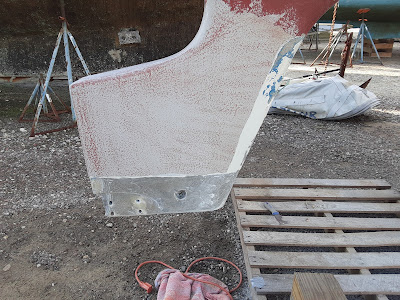
When we hauled out in 2020, we discovered that some previous repairs that we had paid others a lot of money to do needed to be re-done.  One of these needing a do-over was a repair to our rudder skeg.  Fulmar (then called "Nifty Nickers") was damaged during Superstorm Sandy.  She had been hauled out in a boatyard but she was knocked off her jack stands.  The damage was relatively minor but she needed a new rudder.  In 2018, we discovered that her rudder skeg had some delamination (where water gets in through a crack and seeps between the layers of fiberglass), which we believe was a result of the Sandy damage.  It's certainly not surprising to find this out down the road, and it's actually not that difficult if you have modest fiberglassing skills and the right tools.  We paid good money to have it fixed.  The problem was that this original repair only addressed the delamination; the source of the water seepage wasn't addressed.  So, to our surprise, we found that the problem was back when we hauled out again in 2020.  See those two white dots on the skeg?  Those are blisters in the laminate that were filled with water.  The other side was even worse.  So we had to remove the rudder and fix the problem properly, ourselves.


The source of the problem.  Your'e looking up at the bottom of the rudder skeg.  See those cracks running along the outer edge?  The previous repair only addressed the delamination on the starboard side of the skeg, so water was still getting in through the bottom.  This part of the boat is solid fiberglass so there was no danger of flooding the interior.  But the skeg is a very important structural part of the boat that protects and secures the rudder.  This sort of delamination would just weaken that structure over time. 


So, as in most fiberglass repair jobs, we started out with the angle grinder to remove all of the damaged material (including from the bottom of the skeg). 


Grinding fiberglass is like being an archaeologist excavating the remains of some ancient civilization.  You never really know what you're going to find and if you try to work too quickly you can cause a lot of damage. 


We also found some minor cracking at the base of the rudder tube This photo is after we've laid up a few layers of fiberglass cloth and epoxy. 


The same outfit that did the original repair to the skeg, also filled in a couple of unused through-hulls.  We realized later that those repairs were not done very well.  Their repair consisted of sticking a foam plug in the hole (that light-colored bulls-eye in the center of the circle) and smearing thickened epoxy over it on just the outside of the hull.  Not the type of craftsmanship to which you'd want to trust your life.  They didn't use any fiberglass mat or woven cloth and didn't even put a coat of epoxy on the interior side of the plug.  So, again, we grabbed our favorite tool, the angle grinder and faired it back properly, dishing out both the inside and outside surfaces to create plenty of surface area for adhesion.  We then laid up concentric circles of fiberglass mat and woven cloth with epoxy resin on both the inside and outside.  


Janet making some surgical modifications as we get ready to re-install the rudder.  All repairs and bottom painting have been completed.  See how nice those fiberglass repairs on the skeg look?


With the rudder back in and the rudder shoe, or gudgeon, being coaxed back into place with the aid of a come-along fashioned out of the blocks that are normally part of our running backstay.  We love using simple machines to make the work easier.


Right after we bought Fulmar in 2015, we stripped all of the old bottom paint off.  Here the paint has been stripped and we're in the process of fairing (you can see the freshly-applied pink fairing compound that needs to be sanded smooth).

Finishing up the final coat of bottom paint that first spring we owned Fulmar.  Boy that's a lot of jackstands!.  We got tired of repositioning them every time we had to get access to the hull under one of the jackstand pads, so we just brought over more stands and raised and lowered the pads on each of them as needed.  The yard workers at Portland Yacht Services were very accommodating (Portland, ME in 2016).   


2. Sails & Rigging

  • New primary winches (for genoa sheets) (2017)

  • New running backstays (2017)

  • Refurbished base for mast compression post (2017, inspected & repainted in 2021)

  • New cabin-top winches (for halyards and staysail sheets) (2018)

  • New running rigging: mainsail, genoa, staysail, and spinnaker halyards; new genoa furling line; new traveler control lines. (2018)

  • New stack pack mainsail cover & lazy jack system (2020)

  • New staysail cover. (2020)

  • New sun cover on furling genoa (2020)

  • Stripped paint from mast; treated & refinished. (2021)

  • New standing rigging (backstay, headstay, inner forestay, cap shrouds, lower shrouds, topping lift) (2021)

  • New mainsail (2021)*

  • Tune rigging (2022, 2023)


Janet fixing one of Damon's screw-ups (No, the lazy jacks don't attach to the spreaders!). 


Janet and her mom stripping the old sun cover off of the genoa.


3. Engine & Drivetrain

  • Fixed glow plugs (2016)

  • Replaced cutlass bearing* (2018)

  • Replaced gear box* (2018)

  • Replaced alternator mounting bracket (after having the old one welded back together twice). (2018)

  • Fuel tank: remove, clean, inspect, epoxy barrier coat exterior, replace fill hose, rebed/refasten inspection plates, re-secure in place (2021)

  • Resurfaced face of exhaust flange and tapped new threads for mounting bolts to secure exhaust riser (2021)

  • Replaced fuel lift pump (2021)

  • Replaced propeller shaft coupler (2022)

  • Diagnosed and fixed problem with wiring for main power (2022)

  • Replaced engine mounts (and modified brackets) (2022)

The new coupling that connects the propeller shaft to the output shaft of the transmission.  It's a bad feeling when you put the engine in gear and nothing seems to happen.


The main positive power connection to engine's starter.  It was one of the first things we checked when our engine was hesitating to start.  This is on the bottom of the starter and, therefore is impossible to see.  We use the cameras on our phones to peer into spaces where our heads won't fit, to make it possible to read tiny model numbers engraved on engine parts, and to document how things are supposed look before we dismantle them. 


One of the new engine mounts.  You can see that we had to fill the bolt hole for the old mount with epoxy so that we could reposition the new one in the proper location.


Another application of the come-along.  This time it was to help us move the engine so that we could align it properly with the propeller shaft. 


4. Deck

  • New custom bimini (2018)

  • New solar powered vent fan for chain locker (2018)

  • Refurbished, painted & re-sealed cockpit coaming boxes (2019)

  • Refurbished, painted & re-sealed base for engine speed control/gear shift lever (2019)

  • New custom dodger (2022)

  • Installed recessed box for engine gauges & controls (2022)

  • New Davit for hoisting the outboard dinghy motor (2022)

  • Installed bracket to store the dinghy’s outboard motor on the stern rail (2022).

  • Replace gasket and dogs that seal & secure the cockpit sole (soon!)


5. Navigation Equipment

  • New GPS plotter (2017)

  • New magnetic compass (2018)

  • New depth sounder & transducer (2018)*

  • New NMEA 2000 network backbone (2022)

  • New VHF radio (w/ GPS & DSC) (2022)

  • New Vesper AIS (w/ GPS) (2022)

  • New Multifunction Display mounted in a water-tight box (2022)

  • New Radar (on a new Questus backstay mount) (2022)

  • New digital compass (2022)

  • New autopilot (soon!)


Running cables for the radar, AIS, and GPS antennas.  When we replaced the headliner, we made it easy to remove the panels so we could access the space above.  That panel to the right is the top of one of the panels.  That box to the right of Damon's head is the galvanic isolator that we installed. 


When we ordered new navigation electronics, we wanted to house the new multifunction display in one of those fancy instrument pods.  So we ordered one that would fit our MFD but after 4 months of being told it was on back order, we looked for another solution.  It occurred to us that "Hey, we're field biologists. We deploy instruments in the field all of the time and we'd never used a $400 housing for them."  There are much more affordable options for keeping electronic gadgets dry.  We picked up this weather-proof electronics box for about $30 and had it delivered in 3 days.  This shows the front and back of the box, with the B&G multifunction display flush-mounted in the front.


We installed 3 watertight cable glands to get power and data to the MFD housed inside. 


6. Anchoring & Mooring

  • New primary anchor (44-lb Spade 100) and anchor rode (75 ft of 7/16” G4 Hi-Test chain and 225’ of 3/4” braided 8-strand plait) (2017)

  • Made new dock lines (braided 8-strand plait, ⅝ and ¾”) (2017)

  • Made new fender blankets (2017)

  • Replaced anchor windlass (Simpson Lawrence Sea Tiger 555) (2021)

  • New storm anchor (85-lb Mantus M1) and rode (75 ft of 7/16” G4 Hi-Test chain with 250’ of ¾” 3-strand nylon) (2022)


Our new Sea Tiger 555 manual windlass.  We love this work horse.  Lots of people say that you must have an electric windlass, but electric windlasses are one of the achilles heels of modern cruising boats.  The day we can no longer hoist our anchor with a manual windlass is the day that we should stop cruising and switch to RVing.   


7. Electrical

  • Fixed reversed polarity in 120-volt AC shore power system (2016)*

  • Replaced AGM house batteries (4 X 100 Ah) (2016)

  • Rewired mast (new coaxial cable for VHF antenna, new wires for tricolor light, anchor light, steaming light, foredeck light, and spreader lights) (2016, 2021)

  • Replaced navigation lights on mast (tricolor, anchor, and steaming lights) (2016)

  • Replaced deck lights on mast (foredeck and spreader lights) (2016, 2021)

  • Replaced lead acid engine start battery (twice: 2016, 2022)

  • Installed a galvanic isolator (2017)

  • Replaced all cabin lights with LED lights (2017)

  • Installed new two-bank programmable “smart” battery charger and associated wiring (2018)

  • 2 New solar panels (640 watts, total) mounted on a new, custom fabricated frame* (2022)

  • 2 New Victron solar charge controllers* (2022)

  • Replaced 4 X 100 Ah AGM house batteries with 2 X 200 Ah lithium (LiFePO4) batteries (2022)

  • Reconfigured battery restraint systems for both start battery & house batteries (2022)

  • Replaced external regulator for high-capacity alternator with a programmable regulator (2022)

  • Installed alternator protection module, alternator temp sensor, and battery temp sensor. (2022)

  • Replaced main wiring between batteries, engine, alternators, shunt, battery switches, and main breaker panel (2022)

  • Installed new dedicated buss bar for all navigation electronics (2022)


The new 2-bank programmable smart charger.  Luckily, it came with pre-set charging routines for lithium batteries.  So all we had to do was change the charging setting from AGM to LiFePO4 when we installed our new house batteries.


Mocking up the solar panels and frame before biting the bullet.


Putting the new solar panels on their custom-welded frame.


Charge controllers for the solar panels.  We deal with the problem of shading by having a seaparate charge controller for each panel.


Geeking out over the electricity we're producing.  The Victron solar charge controllers connect to our phones via bluetooth, so we can monitor the output of the panels and change settings when necessary (which isn't very often).


The old regulator for our high-output engine alternator.  Our engine has two alternators; one to charge the starting battery (flooded lead acid) and one to charge the house battery bank (LiFePO4). This controls the alternator for our house bank.  It was programmable but really wasn't flexible enough to feed and care for our new lithium batteries, which are power hungry but very fussy about how they get fed.  The new regulator, a Balmar MC 618, has preset charging programs for this type of battery.


8. Plumbing

  • Replaced hoses and fittings for cockpit drains (2016)

  • Replaced manual bilge pump (2016)

  • Replaced hoses for side deck drains. (2016, 2018)

  • Removed manual flush seawater head, holding tank, and associated plumbing. Replaced with a composting head (2018)

  • Replaced flapper valves & diaphram in manual bilge pump (twice: 2019, 2022)

  • Replaced macerator pump for galley sink drain and and associated hoses & antisiphon valve (2017, replaced pump again in 2022)

  • Replaced primary electric bilge pump (800 GPH) (2018)

  • Replaced high capacity electric bilge pump (2500 GPH) (2018)

  • Refurbished both potable water tanks (filled & faired tank flanges, repaired blisters in tank lining, painted interior of tanks with food grade epoxy paint, replaced all tank fittings and valves, replaced lids and gaskets, replaced all hoses (fill hose, vent hose, supply hoses to water pumps) (2022)

  • Replaced all hoses between water tanks, manifolds, pumps, and faucets.  (2022)

  • Installed new manifold to select tanks and pumps. (2022)

  • Replaced pressure water pump (2022)

  • Installed new accumulator tank for pressure water system (2022)

  • Replaced foot pump for galley sink (2022)

  • Installed new water filtration system with its own faucet (2022)

  • Replace reverse osmosis watermaker (in progress!)


The old lid for our aft water tank.  You can see it was made of marine plywood that had been coated with epoxy.  It lasted quite a while but it was cracked and the wood was rotting (we didn't use this tank for this reason). 

Janet applying a food-grade epoxy, called "Brew Coat," to the aft water tank.  The old screw holes had already been filled, blisters repaired, and an epoxy barrier coat applied (that's the grey coating that she is painting over).

After the brew coat dried, we replaced all of the plumbing fittings and filled it water to test for leaks.  Once the new lid was installed we didn't want to have to take it back off to fix any leaks.  Doesn't this look like a beautiful bathtub?


The new Star Board lid.  The water from our refurbished tanks is the sweetest!


9. Galley

  • Modified lid to ice box/refrigerator to add insulation & gasketing (2016)

  • Replaced saloon table (2018) (this new table can also be used as a cockpit table)

  • Raised height of galley counters, installed new Corian countertop, new sink, new manual freshwater faucet, new pressure water faucet, new pressure faucet for filtered water, new teak fiddles around counters, painted fiberglass cabinets and bulkheads, new propane stove/oven (2019)


10. Propane system (for cooking)

  • Refurbished propane locker (Sealed limber hole in outer locker. Refinished drop-in locker to seal penetrations, fix damage to rim, replaced gasket, replaced lid locking mechanism, replaced vent hose, and re-secured drop-in locker to bulkhead. (2017)

  • Replaced the entire propane system including: new tanks, regulator, solenoid valve, hoses, gas detectors, alarm, and system control module (2017) 

  •  New Force 10 gas range (2019)


11. Safety

  • New smoke & CO detectors (2017)

  • New propane gas detectors (2017)

  • New lifesling (2017) (custom canvas cover made for it in 2021)

  • New fire extinguishers (2018, 2022)

  • Replaced lifelines with Dyneema (2020)

  • Installed lifeline netting (to help keep the doggo onboard) (2020)

  • New EPIRB (w/ GPS & AIS transmitter) (2022)

  • Replaced battery in old EPIRB, re-mounted old EPIRB in cockpit locker as a backup. (2022)


12. Other

  • Bulkhead repair in chain locker (wood bulkhead was delaminating.  Cleaned it up and reinforced with epoxy and woven fiberglass). (2018)

  • Replaced Headliner in quarter berth, v-berth, and head (2018, 2022)

  • Custom foam mattress and upholstery in quarter berth (2019)

  • New 6 HP Suzuki outboard for dinghy (2021)

  • Custom dinghy chaps (2021)

  • Custom canvas cover for dinghy (2022) (After making both of these custom items the PVC inflatable dinghy began bursting its seams, with no chance of repair. So we purchased a new Zar Mini aluminum-hulled inflatable dinghy with Hypalon tubes. We still use the cover that was made for the previous dinghy but the beautiful chaps had to be discarded.).


So, as you can see, it's not all sunsets and umbrella drinks aboard Fulmar.  And this is pretty typical of any cruising sailboat.  At least it keeps us from getting too bored, and we always learn something new with each project.